
Santa Barbara's landscape is dotted with many scenic landmarks, of historical value not only to Iloilo but to the whole country as well. Its church, declared by the National Historical Institute as a national historic landmark, was made the headquarters of the revolutionary forces against Spain. And in November 17 1898, its plaza became the site where the Philippine flag was first raised outside Luzon, the event is popularly known as the "Cry of Santa Barbara".
Santa Barbara is also known as a "sport-oriented" community for producing world class athletes like Inocencia Solis ( Dubbed as the fastest woman in Asia during the 50s), Jimmy de la Torre ( Asia'’s marathon king and Santa Barbara's first internationally acclaimed runner). Santa Barbara is also known nationwide for it is the town where football is. It has produced the first “Mr. Football, the late Julio G. Umadhay Jr., of the Philippine Navy.
Furthermore, the oldest golf course in South East Asia is located in Santa Barbara. It was founded in 1907 by 13 Scots who worked at the Philippine Railways then.
Today, it is one of the most promising towns in Iloilo for being the site of the new Iloilo airport set to open in 2007. Although at a standstill until the new airport starts operations, local and national businessmen are already slowly moving and planning on how they will ride the inevitable "boom" the town's economy will be experiencing.
[Tourism] Santa Barbara in Focus
- Roman Catholic Church and Convent - This church, of Baroque Rennaisance architecture, was built in 1845 and was completed 33 years later. In 1898, it was made as the general headquarters and military hospital of the revolutionary forces called "Ejercito Libertador" against Spain in the Visayas. The National Historical Institute declared it as a national historical landmark, in 1991.
- Victory Plaza and Bandstand
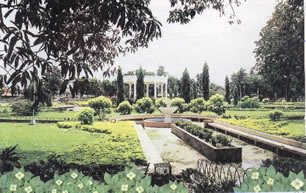
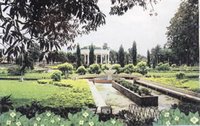 - the town plaza with its beautiful landscape and the Municipal Bandstand, constructed in 1925, it has served as a stage for band and musicians, political rallies, religious program as well as cultural shows and contests since American era. (photo source)
- Cry of Santa Barbara Marker - A historical marker standing in the same site where the Philippine flag was first raised outside Luzon in November 17, 1898. The event is popularly known as the "Cry of Santa Barbara."
- Iloilo Golf and Country Club - The oldest existing golf course in South East Asia. Built in 1907 by a group of Scots, English and American expatriates, who were working in the Panay Railways. The Sta. Barbara Golf Course started as a 9 hole golf course carved from the rolling hills of Sta. Barbara. Today, it is a full A challenging 18 hole golf course (6,056 yardage) nestled in the hills of Sta. Barbara, Iloilo., and plays to a par 70 (more info).
- Monument of General Martin T. Delgado - Found in the northwestern entrance of the town plaza and facing the municipal building stands the statue in bronze of the town's most distinguished son, Gen. Martin T. Delgado. He is the foremost hero of the revolution against Spain in the Visayas as the commander-in-chief of the revolutionary forces in the these region which drove out the colonizers from the Visayan Islands on November 24, 1898.
- Centennial Giant Flag - One of only five giant flags that mark the national trunk sites during the celebration of Philippine Independence in 1998.
- Centennial Museum and Information Center
- Roman Catholic Cemetery - It is one of the oldest landmarks in the town, constructed in 1845. Its facade bears Spanish influences and is one of the stongest structure built during the Spanish time, surviving the test of earthquakes. It is located at Sitio Anggasan, Barangay Duyanduyan.
- Santa Barbara Irrigation Dam - Erected in 1926, the irrigation dam located at Brgy. Tungay is the first gravity irrigation dam in Iloilo. It serves as water supplier of rice fields in Barangay Miraga, Agutayan-Lupa, Lanag, and Cabugao as well as other barangays in Pavia and Leganes, Iloilo.
- MIWD Reservoir - Constructed in 1925. The first waterworks system reservoir in the Visayas and Mindanao.
- The Cry of Santa Barbara is an annual celebration commemorating the historic event that transpired in the town more than a century ago whereby local folk hero Gen. Martin Teofilo Delgado led the uprising against the Spaniards to free the Visayas and Mindanao.
- Kahilwayan it is a cultural festival in a dance-drama from which will showcase the events that led to the historic uprising of the Ilonggos against Spain to its ultimate cry of victory and freedom known to us now as the Cry of Santa Barbara. The Kahilwayan Festival aims to depict the story of the Cry of Santa Barbara in a manner which can bring more color and meaning to the event itself and to draw the interest not only of the people of Santa Barbara but that of other places as well. This is one major way also to develop the tourism industry of the municipality.
- Tribu Kahilwayan is a fledgling tribe composed of students from Santa Barbara National Comprehensive High School and Cadagmayan National High School. The tribe itself springs from the groups that competed in the Kahilwayan Festival of the Cry of Santa Barbara celebration, the debut presentation of which was last November 17, 2001. During the Dinagayang 2002 Festival, Tribu Kahilwayan participated for the first time in the Kasadyahan competition and to the surprise of almost everyone, it was declared the grand champion. It also earn three special awards -- best in choreography, performance and costumes. In 2005, Tribu Kahilyawan also joined as Western Visayas' contingent in Manila's Aliwan Festival (the festival of festivals in the Philippines) where it won 2nd place next to another Ilonggo contingent, Pintados de Passi, and ahead of yet another Ilonggo Contingent, Tribu Silak of the infamous Dinagyang Festival.
- History of the Municipality of Santa Barbara covers four centuries. According to the Agustinian Archives, Vols. 1718, which records the documents on the missionary achievements of the Agustinians missionaries, it bares the historical note that as early as 1617, the missionaries attended to the spiritual ministration of a community or "pueblo" then known as Catmon. The name was derived from a fruit –bearing tree, which served as an imposing landmark in the vicinity. Its total population at the time was 15,094. In 1845, its inhabitants reach a total of 19,719 and covering an area which are now the Municipalities of Zarraga, New Lucena and a part of Leganes and Pavia.
The Revolutionary Government of the Visayas was organized and on November 17 1898, was formally inaugurated at the town plaza of Santa Barbara. A large crowd of people gathered from many places in Iloilo for the historic occasion. The Filipino flag was raised for the first time outside Luzon. The Revolutionary Government Officials were inducted into office and presented to the people who loudly hailed them.
Sta. Barbara became the base of the Revolutionary forces and from here Gen. Delgado launched the campaign to liberate the whole province which culminated in the surrender of Iloilo city by governor-general de los Rios on December 24, 1898.
At the establishment of the civil government Martin Delgado was appointed the first provincial governor of Iloilo and was elected to the same position in the first elections held in 1903. The town began to progress. Better roads and bridges were built that linked Sta. Barbara to the city and other neighboring towns. The railway line between Iloilo and Capiz built in 1906 passes through the poblacion. Sta. Barbara Golf Course – the first in South East Asia was established in 1907 by a group of Scot, English and American expatriates working in Iloilo business.
World War II brought destruction to whatever little progress that were achieved during the Commonwealth period in Sta. Barbara. Only the Roman catholic Church and the Convent, the Elementary school building was spared as they were utilized by the Japanese as garrison. Life was hard for the residents of the poblacion. The town was finally liberated from the Japanese in 1945 with the help of the Americans. Civil government was restored. The last decade of the 20th century ushered in a new form of governance for the local government units. (full version)