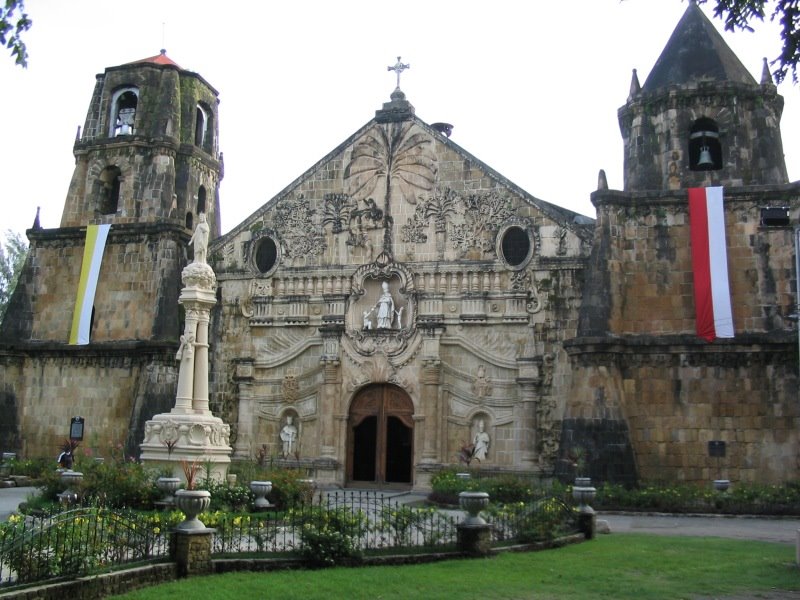
Constructed more than two hundred years ago in the year 1797, the Miagao Church stands as a living legacy of the culture and way of life of the people of Miagao centuries ago, anchored in a strong foundation of Christian faith.
In Baroque-Romanesque style, the church sinks six (6) meters deep into the ground with walls one-and-a-half (1 1/2) meters thick and buttresses thrice thicker in size. A truly 'Philippine Church', it exudes a native touch. Its artistic facade is decorated with a relief sculpture of St. Christopher carrying the Christ child amidst coconut, papaya and guava shrubs. A large stone image of St. Thomas of Villanova, parish patron saint, dominates the center. Carved life-size statues of the Pope and St. Henry with their coat-of-arms above them flank the main entrance. Supporting the facade are the twin belfries, one towering two-storeys and the other three-storeys high.
Like any other foreign influences, the architecture of many colonial churches has undergone the process of indigenization. This process is carried out by incorporating the prevailing Hispano-American and Medieval Spanish architecture with local as well as Muslim and Chinese touches. Thus, the synthesized topology which is anachronistic with the unmindful sues of decorative elements. It had no distinction in terms of periods or orders. Stability and massiveness along with durability associated with sound architecture, was very common. Thus, mission churches were mostly fortresses built for military purpose with some concessions on their facades.
The creative and aesthetic abilities of Spanish colonizers are reflected in many colonial churches in the Philippines. This is especially true in Miagao Church - a world-renowned religious structure now included in the UNESCO World Heritage List.
Learn more about Miag-ao